
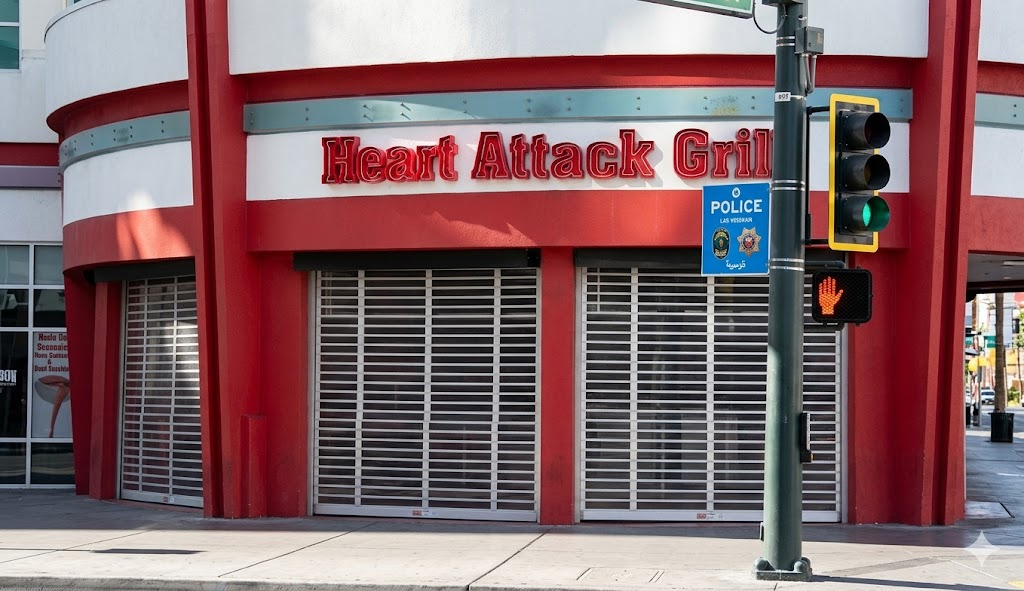
The infamous burger joint blames a “wildly expensive” Las Vegas for its demise. People know the real culprit: the gimmick restaurant is over.
Ask anyone who has actually been to Las Vegas, and they will tell you a truth that eludes the average weekend visitor: our city is not overtly expensive. Step just slightly off the Strip or the Fremont Street tourist traps, and you will find a thriving, accessible culinary scene supported by a robust local economy. Yet, if you read the scathing farewell statement released this week by the owner of the Heart Attack Grill, you would think the city had been entirely paved over with gold leaf.
RELATED: YOU’RE NOT SELLING TO CUSTOMERS ANYMORE, YOU’RE SELLING TO THEIR SHOPPING AGENT
After 15 years of serving up nearly 10,000-calorie “Quadruple Bypass Burgers” on Fremont Street, downtown Las Vegas complete with waitresses in nurse uniforms who paddled patrons for not finishing their meals—the restaurant has permanently closed. In his exit statement, owner Jon Basso squarely blamed the city, declaring that “the soul of Las Vegas has been replaced by corporate greed.” He lamented a landscape now “peddling forty-dollar ‘artisanal avocado toast,’” claiming that the middle class has been entirely priced out of having a good time.
It is a fiery critique. It is also a convenient scapegoat. Blaming “avocado toast” and an imagined city-wide price gouge masks a much harsher, inescapable business reality: the Heart Attack Grill is the latest casualty of the gimmick restaurants. Please, just tell us your target clientele is actually in Pigeon Forge, Tennessee.
Consider the trajectory of similar experiential dining concepts from the past few decades. Establishments like Rainforest Cafe or Dick’s Last Resort once thrived as massive money-makers. They were novelties that turned a standard dinner into a theme park attraction. Consumer tastes mature, and the fatal flaw of the gimmick restaurant is its inherent lack of longevity.
The business model relies heavily on a constant influx of fresh tourists because the core product: the food itself is rarely strong enough to cultivate a loyal, repeat local customer base. When your entire brand identity relies on the shock value of treating gluttony as a spectator sport, your customer acquisition cost is functionally infinite. Locals are not going to spend their Friday nights repeatedly donning hospital gowns to eat lard-fried fries; they will go to the countless reasonably priced, high-quality neighborhood spots that the owner’s statement conveniently ignores.
This highlights the existential trap of the stunt brand. When a company’s identity is tethered to a rigid, uncompromising joke, it backs itself into a corner.Businesses survive market fluctuations through adaptation. But how does a restaurant like the Heart Attack Grill pivot when diners simply outgrow the punchline? It cannot. A brand cannot gracefully introduce a modernized, elevated menu when its waitstaff is contractually obligated to act like medical professionals celebrating cardiac arrest.
The restaurant’s foundation was built on an inflexible premise; to change the menu to meet modern consumer desires would have meant destroying the brand itself.
The Heart Attack Grill did not fail because everyday people can no longer afford to eat in Las Vegas. It failed because a business model built as a static caricature cannot survive in a dynamic market. In business, as in evolution, survival belongs not to the loudest or the most outrageous, but to the most adaptable. When the novelty wore off and the market demanded a change of script, they found they only ever knew one joke.