
Most brands are terrified of backlash, but not for the reasons they should be. It’s rarely about actual business impact. It’s about the feeling of losing control over the narrative. Founders and marketing teams convince themselves that a negative reaction equals a bad decision, so they default to safe, neutral messaging that avoids conflict at all costs. The problem is that in trying to avoid backlash, they also avoid attention, and in today’s environment, attention is the only thing that compounds.
That’s what makes the recent DoorDash moment so instructive.
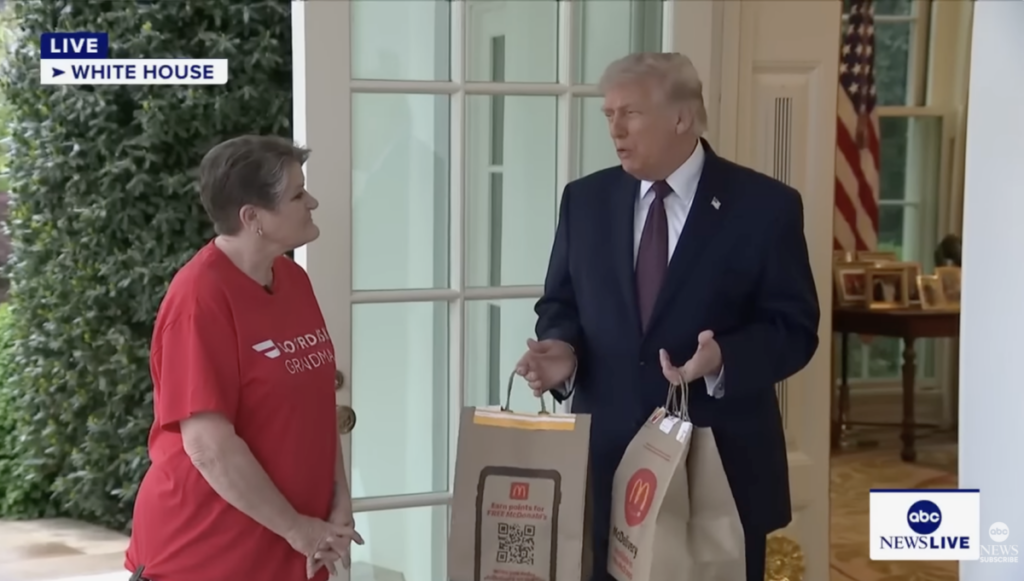
On the surface, it looks like a standard controversy cycle. DoorDash coordinated a McDonald’s delivery to President Trump at the White House, tied to a “no tax on tips” policy, and captured the interaction on camera. The driver praised the policy, Trump tipped her $100, and the clip spread instantly. Within hours, social media filled with angry reactions, boycott declarations, and users announcing they had deleted the app.
Most observers stopped there and assumed the same conclusion they always do: the company alienated a large segment of people and damaged its brand. That interpretation is clean, emotionally satisfying, and completely disconnected from how marketing actually works.
President Trump appeared to accept a McDonald's order from a "Doordash Grandma" before addressing the media at the White House. pic.twitter.com/qvrTHAwS4m
— ABC News (@ABC) April 13, 2026
RELATED: HOW THE WAR IN IRAN WILL IMPACT LAS VEGAS AND BEYOND (WATCH)
Most People Are Measuring the Wrong Thing
The core mistake is confusing visible outrage with meaningful consequences. Social media reactions feel like data because they are loud and immediate, but they are not a reliable proxy for behavior. People say they will delete apps far more often than they actually do. They announce boycotts in public and quietly revert to convenience in private. This gap between stated intent and real-world action is one of the most consistent patterns in consumer behavior, especially in categories like delivery where switching costs are low but habits are strong.
What makes this situation more interesting is that we already have an early signal of what the market thinks. While the outrage cycle was unfolding online, DoorDash’s stock recorded its strongest session in weeks. Investors, who are effectively placing bets on future performance, did not interpret the moment as brand damage. If anything, they saw it as a net positive or, at minimum, a non-event from a financial standpoint.
That contrast reveals something most marketers don’t want to admit: the market is a better scoreboard than the comment section. One reflects aggregated behavior and incentives. The other reflects emotion and identity.
What DoorDash Actually Did
This wasn’t a reckless political stunt. It was a highly controlled positioning move that used politics as a distribution mechanism. DoorDash aligned itself with a simple, intuitive idea: workers who rely on tips should keep more of what they earn. That message is easy to understand, emotionally resonant for a large segment of the population, and perfectly suited for a short-form visual moment.
The execution was what made it effective. Instead of explaining the idea through a campaign or a series of ads, they compressed the entire narrative into a single, shareable scene. A DoorDash delivery. A president. A driver being recognized and tipped. The story didn’t need a headline or a caption to make sense. It was inherently legible, which made it easy to circulate, debate, and reinterpret across platforms.
Just as importantly, they leveraged one of the most powerful media amplifiers available. The presidency functions as a distribution engine that most brands will never have access to, and DoorDash managed to plug into it with minimal cost. The entire moment was engineered for maximum reach relative to investment, which is exactly how high-leverage marketing should operate.
DOORDASH HITS THE OVAL OFFICE. 🍟
— The White House (@WhiteHouse) April 13, 2026
$11,000 refund DELIVERED — all thanks to No Tax on Tips!
Millions of drivers across America are leveling up this tax season. 💸 pic.twitter.com/nobBT1kBJU
RELATED: GARAGE BEER SHOWS MOST BRANDS DON’T NEED BETTER CONTENT. THEY NEED A PERSONALITY.
Backlash Was the Multiplier, Not the Problem
The outrage that followed wasn’t a failure of the campaign. It was part of the amplification system. When people argue about a piece of content, they extend its lifespan, increase its visibility, and introduce it to new audiences who would not have encountered it otherwise. Controversy, when tied to a clear and understandable narrative, acts as a distribution accelerant.
This is where most brands miscalculate. They treat backlash as something to be avoided entirely, rather than something to be evaluated.
The real question is not whether people are upset. It’s whether the people who are upset matter to the business in a measurable way. If the backlash comes from segments that are not core customers, not high-value users, or not aligned with the brand’s long-term positioning, then the practical impact is often negligible.
In DoorDash’s case, there is no evidence—at least so far—that the outrage translated into meaningful customer loss, reduced order volume, or damaged partnerships. Without those signals, the backlash remains exactly what it appears to be: a loud, temporary reaction that helped the campaign travel further.
The Real Risk Is Playing It Safe
What this moment exposes is a deeper issue in how most companies approach marketing. The instinct to avoid backlash leads to messaging that is technically correct but strategically useless. Brands end up producing content that offends no one and resonates with no one. It gets posted, it exists, and then it disappears without impact.
This is the hidden cost of playing it safe. There are no angry tweets, but there is also no attention, no memorability, and no narrative advantage. Over time, this creates a slow erosion of brand relevance. The company becomes invisible, not because it lacks resources or capability, but because it refuses to take positions that generate meaningful engagement.
In that context, backlash is not the worst-case scenario. It is evidence that the brand has entered the conversation at all.
Trump: "Do you think that men should play in women's sports?"
— The Bulwark (@BulwarkOnline) April 13, 2026
Doordash driver: "I really don't have an opinion on that."
Trump: "You don't? I bet you do."
Doordash driver: "No, I'm here about…"
Trump: "Pizza."
Doordash driver: "No tax on tips." pic.twitter.com/atZScsVplo
RELATED: THE LINE BETWEEN REAL AND FAKE IN CAMPAIGN ADS IS ALREADY GONE
What Smart Operators Do Differently
Operators who understand how attention works approach these situations with a different set of questions. They are not trying to eliminate risk; they are trying to define it. Instead of asking whether a campaign might upset people, they ask which groups are likely to react negatively and whether those groups are strategically important to the business.
They also design their campaigns so that the core message can survive distortion. In a polarized environment, any message can and will be reframed by different audiences. The goal is not to prevent reinterpretation, but to ensure that the original idea is strong enough to remain intact even as people argue about it.
Finally, they measure outcomes that actually matter. App usage, retention, order frequency, partner relationships, and revenue trends tell you whether a campaign worked. Social sentiment provides context, but it should never be the primary decision-making metric. Treating it as such leads to reactive, defensive marketing that prioritizes avoiding criticism over creating impact.
So Donald Trump passes no tax on tips. Which benefits door dashers….. Who are in general part of the lower to mid class…… And doordash thanks him for it. Democrats ( Also lower to mid class majority ) Are now quitting thier jobs and canceling doordash….. Over a bill that…
— Iliftfordoughnuts (@AndriaDont99498) April 14, 2026
RELATED: THE AFROMAN CASE WASN’T ABOUT THE RAID, IT WAS ABOUT WHO WON THE INTERNET
The Bottom Line
Backlash is not a verdict on your marketing. It is a reaction to it, and reactions are a sign that something broke through the noise. The only meaningful question is whether that reaction translates into changes in behavior that affect the business.
If customers leave, revenue drops, or key relationships deteriorate, then the backlash matters. If those things remain stable or improve, then the outrage was simply the cost of attention. Most brands are unwilling to pay that cost, which is why they remain forgettable.
DoorDash made a calculated bet. They accepted that a segment of the audience would react negatively in exchange for a stronger, more visible position tied to a clear idea. Early signals suggest that the business did not suffer for it. If anything, it benefited from the exposure.
For marketers and founders, the lesson is straightforward. The goal is not to avoid backlash. The goal is to understand it, anticipate it, and decide whether it is a price worth paying for attention that actually moves your business forward.