
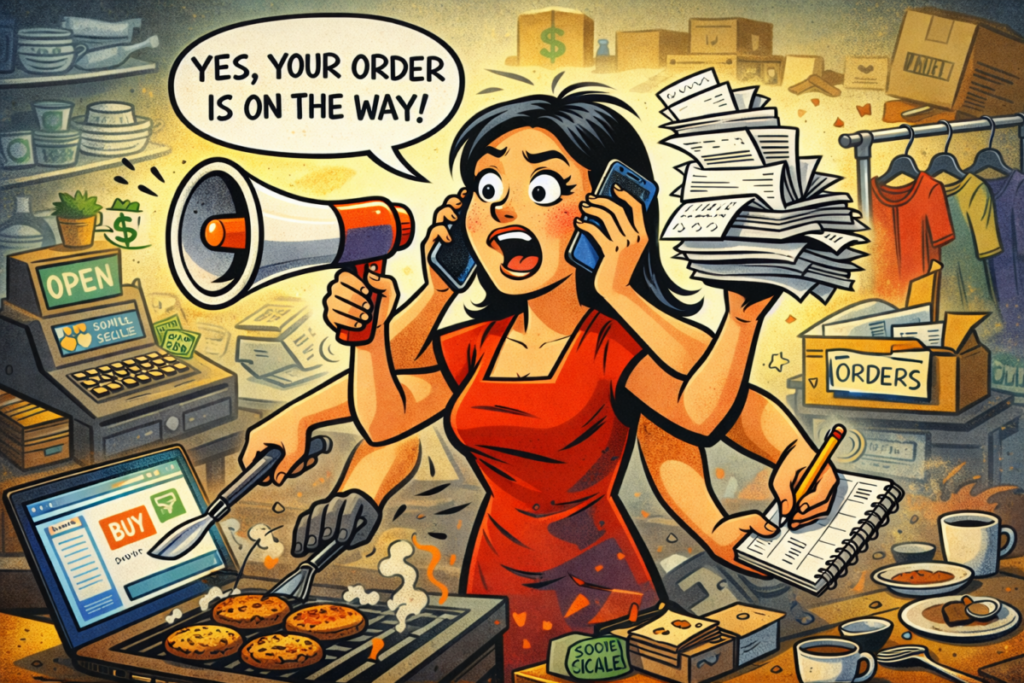
Most business owners do not plan to do their own marketing forever. It usually starts as a practical choice. Cash is tight. You want to understand the basics. A free course feels safer than a long-term commitment.
The problem is that what begins as a short-term solution often turns into the system. Weeks turn into months. Marketing becomes something you manage between meetings, late at night, or on weekends. At some point, you are no longer learning marketing. You are carrying it.
That is where the real cost shows up.
Your time is the most expensive input you have
Once a business has real revenue and real complexity, the owner’s time becomes the highest value resource in the company. Even conservatively, many founders are worth at least one hundred fifty dollars an hour by the time they reach the mid six figures.
DIY marketing quietly consumes ten to twenty hours a week. Writing content. Posting on social. Setting up emails. Tweaking ads. Reading forums to figure out why something did not work.
Fifteen hours a week at that valuation adds up fast. That is roughly nine thousand dollars a month in owner time spent on work that is not core to running the business.
That time does not come from nowhere. It comes from sales conversations that did not happen. Partnerships that never got explored. Hiring that got delayed. Systems that stayed undocumented. These are the areas that actually move revenue and enterprise value forward.
Opportunity cost compounds faster than mistakes
While you are figuring things out piece by piece, competitors who use specialists are not standing still. They are testing faster. They are narrowing their focus. They are compounding small improvements week after week.
Marketing has learning curves that are not kind to part time effort. SEO and paid media often involve months of experimentation before results stabilize. During that period, most DIY setups overspend and underperform. That is not a failure of intelligence. It is the cost of learning without context.
The longer a founder stays stuck in that loop, the more other parts of the business stall. Margin work gets postponed. Processes remain undocumented. New offers stay half built. Those delays are rarely tracked, but they are far more expensive than a weak campaign.
DIY marketing is not actually free
Even lean DIY setups come with real expenses. Tools. Software. Hosting. Email platforms. Ad-spend. Many small businesses spend several hundred dollars a month before counting a single hour of their own labor.
Once you value that time realistically, the numbers change. A modest tool stack plus sixty hours of owner time can easily exceed three thousand dollars a month in true cost. Often more.
At the same time, many focused marketing retainers land between one and five thousand dollars a month. When done well, that spend usually brings better targeting, less waste, and faster learning than a founder juggling everything alone.
The comparison is not free versus paid. It is unfocused effort versus leverage.
Effort does not equal performance
One of the hardest parts of founder led marketing is that it feels productive. You are busy. You are posting. You are learning. You are trying.
But marketing performance depends on details that non specialists often miss. Geo targeting errors. Broad keywords without filters. Missing conversion tracking. Content built around visibility instead of intent. These mistakes burn budget quietly.
Founder driven marketing also tends to chase immediate feedback. Likes. Views. Comments. Those signals feel reassuring, but they rarely build durable assets. Positioning, funnels, systems, and repeatable acquisition get deprioritized because they do not reward effort quickly.
That is why many DIY setups plateau. Not because the founder lacks discipline, but because the structure is wrong.
The emotional and strategic tax adds up
When you are the marketing engine, the business becomes tightly coupled to your output. Visibility depends on your consistency. Momentum depends on your energy. Growth depends on your willingness to keep performing.
That makes the business harder to scale and harder to value. It also makes decision making more personal. Every slow week feels like a judgment. Every post carries weight it should not have to carry.
Over time, that pressure erodes clarity. Burnout becomes more likely. Strategic thinking becomes harder when you are too close to the execution.
When doing it yourself makes sense and when it does not
DIY marketing can make sense early on. If revenue is still low and the goal is survival or proof of concept, learning the basics is rational. It can also make sense if marketing is something you genuinely want to master long term.
It becomes a liability when your calendar is full of marketing tasks and the rest of the business starts lagging. It becomes a liability when the time and money you are spending would produce better results if redirected toward focused help.
A simple test often makes this clear. If you stopped doing day to day marketing for sixty to ninety days, what would happen. Would everything fall apart, or would visibility dip while operations kept moving?
If everything collapses, the cost of doing your own marketing is already too high.
Strategy is not about doing more yourself
The businesses that scale are not the ones where founders know the most tactics. They are the ones where founders decide what deserves their attention and what does not.
Hiring marketing expertise is not about giving up control. It is about buying back time, focus, and momentum. It is about letting specialists handle work that requires repetition and context so you can concentrate on running the business.
Doing your own marketing often feels responsible. In practice, it is one of the most expensive ways to grow once the business is real.