
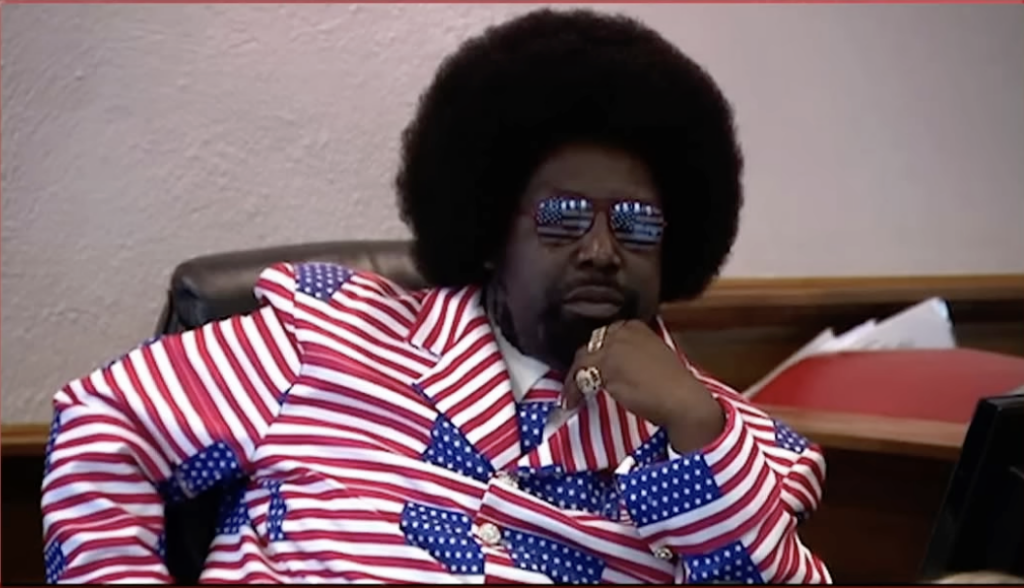
Most people look at the Afroman situation and see a police raid, a lawsuit, and a strange celebrity story that somehow spiraled out of control. That’s not really what happened. What actually played out was a real-time case study in narrative control—specifically, what happens when one side understands how the internet works and the other side doesn’t.
Because the moment this stopped being about a raid and started being about a lemon pound cake, the outcome was already tilting in one direction.
Most People Think This Is About Law. It’s About Story.
The default playbook in situations like this is predictable.
Something happens, lawyers get involved, everyone goes quiet, and eventually a carefully worded statement gets released while the story slowly fades out. That approach assumes time is your ally and attention will move on.
Afroman didn’t follow that script. He had footage—real, unpolished, slightly chaotic footage—and instead of burying it, he turned it into content. Not a defensive statement, not a legal explanation, but something the public could actually watch and react to. That decision shifted the entire dynamic, because once people can see events unfold for themselves, they stop relying on official interpretations and start forming their own conclusions.
At that point, the question is no longer “what happened?” It becomes “who does this feel like?” And the internet answers that question quickly.
Ok, someone please explain to me the Afroman court case situation as simply as possible. I’m suddenly seeing everything about it on my feed.
— Steve Gruber (@stevegrubershow) March 24, 2026
Thank you for your attention to this matter!
RELATED: WHAT HAPPENS TO LAS VEGAS DURING A RECESSION?
The Cake Was the Turning Point
Every story has a moment where it simplifies, and in this case, it happened in the most unexpected way possible. A serious police raid somehow produced a viral clip of a deputy pausing to look at a lemon pound cake. That single image collapsed a complicated situation into something instantly recognizable and shareable.
NEW: Afroman's music video "Lemon Pound Cake" played in court as "Officer Poundcake" was forced to sit and watch.
— Collin Rugg (@CollinRugg) March 18, 2026
Adams County Sheriff's deputies are suing Afroman after he released a music video following a botched raid on his home.
At one point during the trial, the video was… pic.twitter.com/NMh2QT3lMN
From there, the narrative took on a life of its own. The clip became a meme, the meme became content, and the content became an ongoing theme that Afroman leaned into across music, videos, and interviews. Instead of trying to steer the conversation back toward seriousness, he allowed the absurdity to carry the story forward.
That’s the part most organizations struggle with. They try to regain control by tightening the message. Afroman did the opposite. He let the moment breathe, and then built on top of it in a way that kept people engaged rather than defensive.
RELATED: CHUCK E. CHEESE DIDN’T COME BACK BECAUSE OF MARKETING
The Response Made It Worse
From the deputies’ perspective, the situation was understandably frustrating. Their images were circulating online, they were being mocked, and the incident was no longer contained to a local event. Wanting to protect their reputations is a completely human response.
But the decision to file a lawsuit changed the optics of the situation almost immediately. What may have been intended as a legal remedy came across publicly as a group with institutional power trying to silence an individual who used footage from his own home. Regardless of the legal nuances, the visual was simple and easy to interpret.
And in public perception, simple usually wins.
That shift turned the story from “what happened during the raid” into “why are they going after him,” which is a much harder position to defend in the court of public opinion.
The Internet Doesn’t Let Things Disappear
Before the lawsuit, the story was already circulating. After the lawsuit, it expanded significantly. Media coverage increased, commentary spread across platforms, and more people were exposed to the original content than would have otherwise encountered it.
This is the part organizations consistently underestimate. Attempts to suppress or remove content often act as accelerants, not solutions. The act of trying to make something go away signals that it matters, which invites more attention rather than less.
By escalating the situation, the deputies unintentionally ensured that the narrative would reach a much wider audience and stick around longer than it otherwise might have.
BREAKING: Jury sides with Afroman, who was sued by sheriff's deputies after he made a music video with surveillance of them raiding his home.
— Collin Rugg (@CollinRugg) March 18, 2026
The deputies said posts & the music video caused "humiliation, ridicule, mental distress, embarrassment, & loss of reputation."
Afroman… pic.twitter.com/dgU3doduzO
RELATED: THE SAVANNAH BANANAS DIFFERENCE: 5 MODERN MARKETING TIPS
This Was Always a Framing Battle
At its core, this situation wasn’t just about facts. It was about how those facts were framed.
Afroman’s framing leaned into themes that already resonate with a broad audience: free speech, individual rights, and skepticism toward authority. Those ideas are culturally durable and easy to rally around.
The deputies’ framing, by contrast, focused on embarrassment and reputational harm. While valid on a human level, those points are harder to scale into a compelling public narrative, especially when positioned against broader cultural values.
When one side is operating on a values-driven frame and the other is operating on a personal one, the outcome is usually predictable.
People align with the story that feels bigger than the individuals involved.
What This Actually Means
What makes this case interesting is not the incident itself, but how it was handled. Afroman didn’t control what happened, but he controlled how it was interpreted and distributed. He turned documentation into content, content into narrative, and narrative into renewed relevance.
At the same time, the institutional response followed a familiar pattern of treating a narrative problem like a legal one. That approach assumes authority and process will carry weight, but in today’s environment, those factors are often secondary to perception and shareability.
The result is a mismatch between how decisions are made internally and how they are received externally.
The Bottom Line
The internet doesn’t reward authority in the way it once did. It rewards clarity, relatability, and stories that people can quickly understand and repeat. Humor, even in serious situations, can make a narrative more durable, not less.
Afroman understood that instinctively, whether by design or by feel. The deputies approached the situation through a more traditional lens, where control is maintained through formal channels.
Those two approaches collided in public, and once the story became something people could laugh about, reinterpret, and share, the outcome was no longer being decided in a courtroom.
It was being decided in the feed.