
What CEOs and Startups Can Learn from MVP Promotions and the Business of Attention
Jake Paul didn’t succeed in boxing because he fought well.
He succeeded because he understood attention, narrative, and distribution better than the institutions built to control the sport.
That distinction explains not only his rise, but why legacy industries across media, sports, and business are being outpaced by creators and founders who treat influence as infrastructure — not decoration.
At Marketer on the Run, we analyze moments like this not as fans, but as strategists advising brands and organizations navigating modern attention economies. Jake Paul’s impact on boxing is one of the clearest case studies of how relevance is rebuilt in real time.
Jake Paul, By the Numbers
Before diving deeper, let’s ground the conversation in measurable impact — not hype.
Reported and estimated results from Jake Paul–led events include:
- Multiple fights with hundreds of thousands of pay-per-view buys, including ~500,000 on early Paul vs. Woodley cards.
- Estimated 2.75+ million cumulative PPV buys across his boxing career.
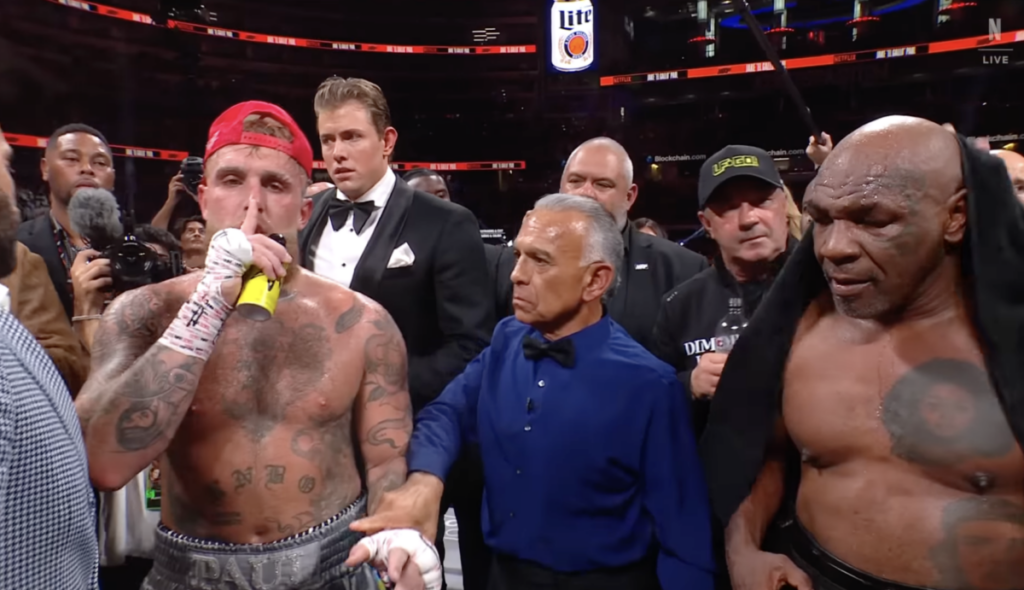
- Over 108 million global viewers tuned in live for Paul vs. Tyson on Netflix — making it one of the most-watched sporting events ever.
- 60+ million households streamed Paul vs. Tyson live, with tens of millions watching co-main events featuring women’s boxing.
- Record-breaking fight gates, with over $18 million in ticket revenue reported for Paul/Tyson + Taylor/Serrano 2.
These aren’t fringe wins — they’re commercial footprints.
Before Influencer Boxing, the Sport Was Stuck in Neutral
Long before Jake Paul—and later his brother Logan—stepped into a ring, boxing was already struggling with a slow structural decline.
Legacy promotion models relied on entrenched gatekeepers, multiple sanctioning bodies, and sporadic marquee fights — all while younger audiences drifted away. Industry reporting around that time showed boxing PPV buys clustered around a handful of aging stars, with mid-tier cards routinely underperforming. The average PPV buyer skewed older, while Gen Z and millennials migrated toward MMA, esports, and digital entertainment.
Boxing wasn’t dying.
But it was losing relevance.
That’s the environment the Paul brothers entered.
What Influencer Boxing Actually Is — and Why It Worked
Influencer boxing didn’t succeed because audiences forgot what real boxing looks like.
It succeeded because it mirrored how modern audiences form emotional investment:
- Pre-existing attention transfers into event engagement
- Narrative exists before contracts are signed
- Digital familiarity lowers friction for PPV purchases or live streams
Traditional boxing asks fans to care after a fight is announced. Influencer boxing monetizes pre-existing attention first — turning followers into live-event customers.
That’s not dilution — it’s distribution evolution.
How Influencer Boxing Reintroduced a New Generation to the Sport
In practice, influencer boxing acted as a gateway, not a replacement.
Millions of younger fans:
- Bought their first boxing PPV
- Learned the language of the sport
- Followed full fight cards, not just influencer names
- Discovered traditional pro fighters through undercards
Jake Paul understood this immediately: attention precedes revenue. By activating audiences already familiar with him online, he rebuilt anticipation around fights — whether on DAZN, ESPN+, or Netflix.
Boxing’s Real Problem Wasn’t Talent — It Was Relevance
Boxing didn’t lack competition.
It lacked modern framing.
Jake Paul recognized that fights were still compelling — but the packaging, promotion, and channel strategy were outdated. Instead of assimilating into boxing’s hierarchy, he treated the sport like a content vertical in need of rebranding — and that shift changed everything.
From Misfits Boxing to Netflix: Building Momentum Before Validation
Paul’s early alignment with Misfits Boxing, a creator-driven league standing outside traditional promotion, proved a new model could work. These events routinely drew strong PPV buys, demonstrating the profitability of creator-led promotion outside the elite legacy system.
That proof of demand laid the groundwork for larger platforms — including Netflix, which hosted multiple Paul fights. Rather than hoping for acceptance, Paul’s model forced visibility.
Netflix didn’t choose him because he fit boxing’s image.
They chose him because he fit modern entertainment economics.
The PFL Partnership: When Institutions Follow Attention
One of the clearest signals of Jake Paul’s brand power is his multi-year partnership with the Professional Fighters League (PFL), a major MMA organization.
This wasn’t novelty. It was strategic alignment.
PFL leadership openly cited Paul’s ability to deliver:
- audience expansion
- crossover appeal
- sponsor interest
- cultural relevance
Paul brought what many leagues struggle to build organically: attention at scale.
Institutions resist disruption — until they need it.
Jake Paul Is a Brand First, a Fighter Second — and That’s the Point
Jake Paul entered boxing with advantages most fighters never have:
- a massive audience
- a defined persona
- direct communication channels
Instead of chasing validation from promoters or sports media, he brought leverage.
He didn’t wait to be explained.
He explained himself — daily.
That inversion of power is the disruption.
Audience Is the Asset: Jake Paul’s Reach by the Numbers
When we say Jake Paul is a brand first, we’re not speaking metaphorically. We’re describing infrastructure.
As of December 2025, Jake Paul commands one of the largest personal media footprints in global entertainment:
- Instagram: 25+ million followers
- YouTube: 20+ million subscribers
- TikTok: 18+ million followers
- X (Twitter): 4+ million followers
- Cumulative social reach: well over 65 million followers across major platforms
That audience isn’t passive. It’s:
- platform-native
- habituated to long-form and live content
- accustomed to converting attention into action
This is why Paul never needed boxing’s permission to matter.
Most fighters enter the sport hoping promoters will introduce them to an audience. Paul entered with an audience already assembled — and used boxing as the arena, not the foundation.
From a marketing perspective, this is the inversion that legacy industries still struggle to process:
Jake Paul didn’t borrow attention from boxing.
Boxing borrowed attention from Jake Paul.
That dynamic explains:
- his leverage in negotiations
- his ability to headline cards immediately
- his appeal to platforms like Netflix
- his value to institutions like the PFL
When you control distribution at that scale, you don’t audition.
You dictate terms.
For CEOs and founders, the lesson is uncomfortable but clear:
Audience ownership is bargaining power — and in modern markets, it often matters more than credentials, titles, or legacy approval.
MVP Promotions: A Media Company Wearing Boxing Gloves
Founded in 2021, Most Valuable Promotions (MVP) is the boxing promotion company co-founded by Jake Paul and Nakisa Bidarian.
It operates less like a traditional boxing promoter and more like a media company managing intellectual property, with fighters treated as narrative assets across social and streaming platforms.
MVP understands:
- attention is built daily
- fighters are audience drivers
- digital platforms are primary distribution
The bout is the climax. The content is the business.
How Jake Paul Became the Most Influential Promoter in Women’s Boxing
No modern promoter has elevated women’s boxing at scale the way Jake Paul has.
Amanda Serrano’s high-profile bouts under MVP — including Netflix card viewership counted in the millions — set new benchmarks for women’s boxing. The Taylor vs. Serrano trilogy drew nearly 6 million average viewers on Netflix.
This wasn’t symbolic progress. It was commercially validated progress.
“Is This Just Celebrity Boxing?”
This critique is common — and easy to answer.
Celebrity boxing doesn’t:
- sell out major arenas
- draw 108 million global viewers on a streaming debut
- break fight gate records
- generate sustained institutional partnerships
- elevate women’s boxing to mainstream viewership numbers
These are market outcomes, not niche novelty.
When the Establishment Hates You, Pay Attention
Jake Paul’s loudest critics — including figures like UFC President Dana White and boxing promoter Eddie Hearn — often surface after his numbers command attention.
Incumbents don’t attack irrelevance.
They attack threats.
Paul disrupted control over:
- matchmaking
- narrative
- audience access
That reaction is often confirmation, not condemnation.
Turning Attention Into an Ecosystem
Paul didn’t stop at fight revenue.
Fight weeks became multi-channel monetization events, driving:
- merchandise sales
- sponsorships
- corporate partnerships
- ventures like his brand Bettr
One flagship product generated attention.
The ecosystem benefited.
That’s modern growth strategy.
The CEO Takeaways
- Distribution beats credentials.
- Narrative drives revenue.
- Audience comes before monetization.
- Criticism often confirms traction.
- Direct relationships outperform intermediaries.
Boxing Was Just the Case Study
Jake Paul didn’t exploit boxing, he exposed how much value the industry was leaving on the table.
By re-centering attention, narrative, and distribution, he brought:
- younger buyers
- new revenue streams
- global audiences
- institutional partnerships
The same forces are reshaping media, politics, and business.
Jake Paul just proved it under the brightest lights.
At Marketer on the Run, we study these moments not to celebrate personalities — but to understand power.
The companies that win the next decade won’t be the most credentialed.
They’ll be the most fluent in attention.
Ready to Get Things Running?
If you’re tired of guessing what’s actually working in your marketing—and would rather have someone who sees the whole board—reach out to schedule a discovery call.