
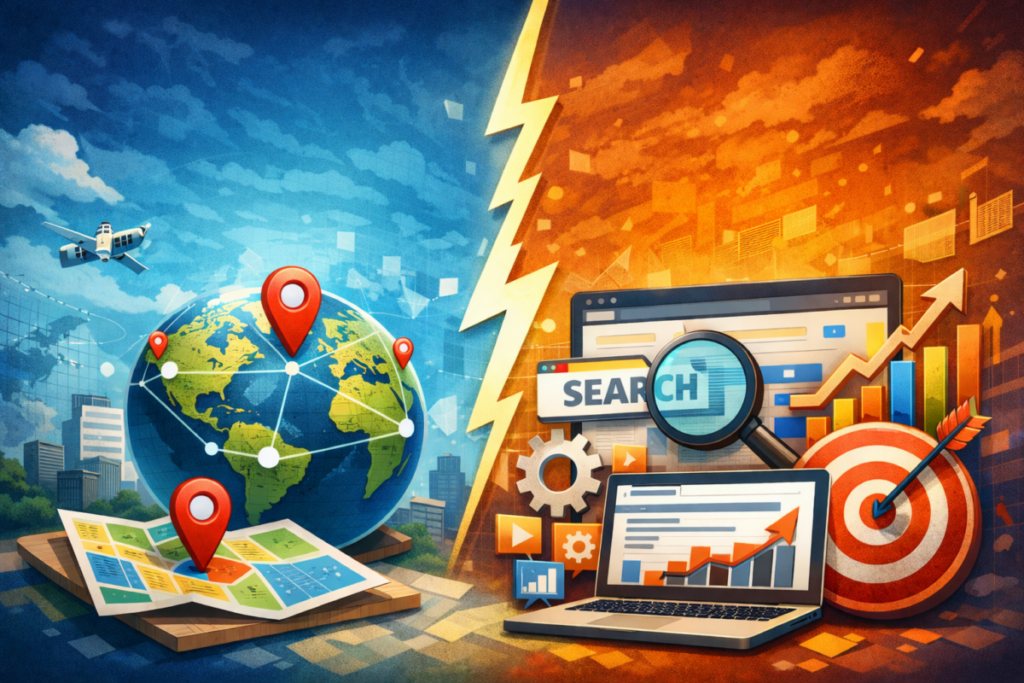
GEO vs SEO is becoming a real question for businesses that rely on online visibility. Search is changing, and the way people find information is shifting with it. If your marketing strategy still assumes that search only happens on Google, you are already behind.
SEO is not dead, as many are claiming on social media. It is just shifting.
What SEO still does well
Search engine optimization (SEO) is focused on helping your website appear in traditional search results. SEO is built through content on the page as well, content structure, and some off page optimization like meta descriptions. When someone types a query into Google and clicks a link, SEO is doing its job.
For most businesses, SEO is still a strong source of steady traffic. Blog posts, service pages, and evergreen content still matter. Rankings, search intent, and backlinks still are important aspects of getting found in search.
What has changed is how often users stop at a list of links like search results.
What GEO actually means
GEO stands for generative engine optimization. It focuses on how your content is interpreted, summarized, and surfaced by AI systems instead of traditional search engines. These systems do not send users to ten search result links. They generate answers.
When someone asks a question inside an AI tool, that system pulls from many sources, rewrites information, and presents a single response. GEO is about increasing the chances that your ideas, language, and expertise shape those answers.
This is not about keywords in the traditional sense. It is much more about clarity, structure, credibility, and consistency across the web.
GEO vs SEO in real terms
The difference between GEO vs SEO comes down to how information is delivered.
SEO helps users find your website.
GEO helps your expertise appear even when users never visit your site.
SEO rewards optimization for crawlers and rankings.
GEO rewards content that is easy to understand, well cited, and trusted across multiple platforms.
SEO focuses on pages.
GEO focuses on ideas.
Businesses that rely only on SEO risk becoming invisible in AI driven search experiences. Businesses that ignore SEO completely lose traditional search visibility. SEO and GEO work best when used in tandem.
What this means for businesses
For businesses across industries, GEO vs SEO is not an either or decision. It is a layering decision.
Your website still needs strong SEO. It needs clear service pages, thoughtful blog content and solid technical SEO behind the scenes. But that same content also needs to be written in a way that AI systems can parse, summarize, and reuse accurately when providing answers.
That means using fewer buzzwords. Instead use clear explanations and specific examples. Use first hand experience to support your claims. Use consistent messaging across platforms like your website, podcasts, interviews, and social profiles. AI engines look for patterns.
Authority now comes from repetition and clarity, not just backlinks.
How to adapt without starting over
You do not need to toss out your existing content. Most businesses already have what they need to start incorporating GEO. The shift comes from restructuring how that content is created and shared.
Start by tightening up the language and avoiding vague positioning on your website and in blog posts. Explain concepts as if someone unfamiliar with your field is reading the information. Answer questions directly before expanding on them. For example, if you look at the introduction to this article, it explains that your approach has to shift in the very first paragraph.
The goal is to make your expertise easy to extract and hard to misinterpret.
Why this matters long term
GEO vs SEO is not a trend. It is a fundamental change in how people access information. Attention spans are getting shorter and AI is providing quick answers which means fewer clicks and an audience with less patience for digging for the answers they are looking for.
Businesses that adapt early will shape how their expertise is represented. Those that wait will continue to see fewer and fewer visitors to their websites.
Visibility is no longer just about search rankings. It is about overall representation.
Where strategy comes in
This shift to incorporating both SEO and GEO is not about having the right expensive tools or gaming content delivery systems to get more clicks. It is all about strategy. Businesses that invest in clear positioning, thoughtful content, and long term messaging will perform better in both SEO and GEO environments.
The work does take longer than just throwing up a piece of content. But that effort compounds and leads to more relevant visitors.