
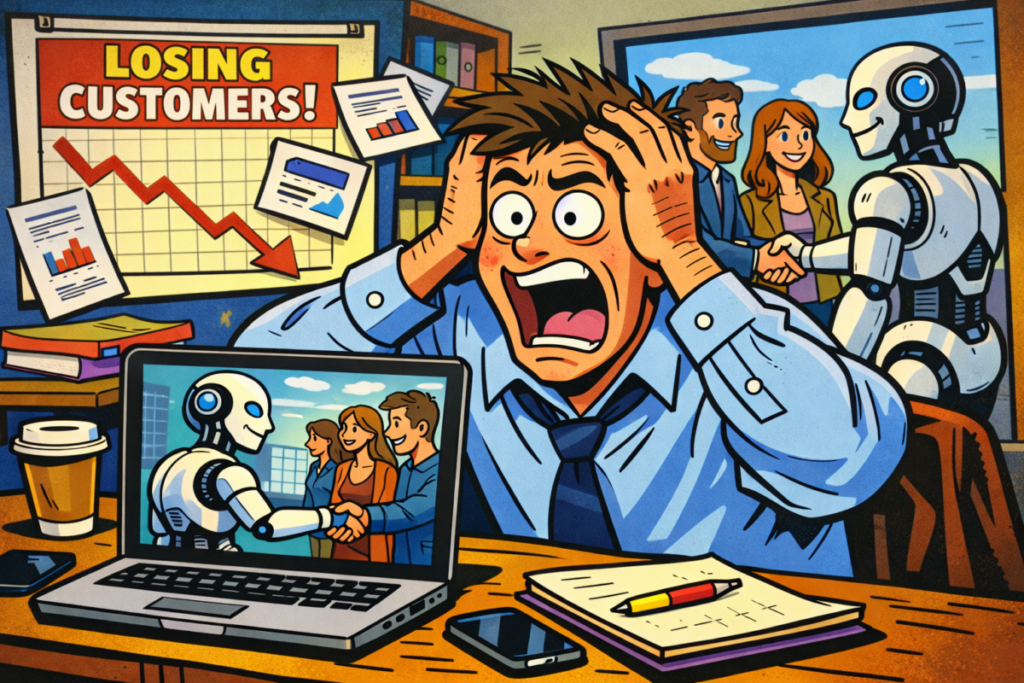
In many marketing plans, search still plays the same role it always has. Content is built to rank. Performance is tracked through traffic and leads. SEO sits alongside paid media and email as one of the main ways buyers are expected to find their way in. Those assumptions still shape how budgets are set and how success is reported.
But the path buyers take before they ever reach a website is shorter, narrower, and far more mediated than it used to be. That gap between buyer behavior and marketing strategy is where problems are starting to show up.
How Buyers Are Actually Using AI Search
Buyers are no longer typing short keyword phrases and browsing their way through a results page. They are asking specific, contextual questions that describe their situation in full. A healthcare administrator might ask for EHR platforms that work for a multi-location practice under a certain size. A founder might ask for CRM tools that integrate with a very particular stack. The response they receive is an AI explanation that compares options, outlines tradeoffs, and narrows the field before links are even presented.
For many buyers, that answer becomes the decision.
Studies and usage data already show that generative summaries reduce clicks to traditional results significantly. Users often stop at the AI overview, not because they are lazy, but because the answer feels complete enough to move forward. Discovery no longer begins with browsing. It begins with machine selected recommendations.
What Changed in Buyer Behavior
The biggest shift is not speed. It is compression.
The traditional buying journey assumed that time was spent researching across multiple sources. Awareness led to consideration. Consideration led to evaluation. Evaluation led to vendor conversations. AI search collapses those traditional stages. Education, comparison, and shortlisting now happen at all at once, often before a buyer ever encounters a brand directly.
AI tools have become early-stage advisors. They frame the category. They define what matters. They surface which options are credible. By the time a buyer reaches a website, much of the thinking has already happened.
Why the Old Marketing Playbook Is Breaking
Most marketing teams are still optimizing for an older search method. Strategies are built around ranking pages, capturing clicks, and pushing prospects through funnels designed for longer journeys. Success is measured through sessions, keyword positions, and last click attribution.
That model struggles in an AI first environment.
When answers are delivered directly inside the search experience, traffic declines do not necessarily mean influence declines. It means influence is happening elsewhere. Ranking first matters less than being cited. Being persuasive matters less than being precise.
Marketing teams that continue to focus primarily on traffic risk missing where real decisions are being shaped.
Why Most Teams Have Not Adjusted
Part of the delay is structural. Search, content, brand, and PR often sit in separate silos. No single team owns the question of how the brand appears inside AI generated answers. Without clear ownership, communication lags, and adaptation stalls.
Another issue is measurement. Many organizations still rely on metrics that made sense in a click driven world. Website visits, impressions, and conversion paths feel concrete, even as their connection to revenue weakens. Authority inside AI systems is harder to track, so it is easier to ignore.
Finally, many teams are still producing content designed to perform for algorithms rather than content designed to explain. Keyword driven articles, surface level blog posts, and promotional copy do not hold up well once they are removed from their original context and summarized by a model.
What Adjusting Actually Looks Like
Adjusting does not mean abandoning SEO. It means expanding the definition of visibility.
Marketing teams that are adapting focus on authority over volume. They publish fewer pieces, but those pieces go deeper. Clear comparisons. Detailed FAQs. Implementation guidance. Explicit explanations of who a product is for and when it is not a fit. This kind of content gives AI systems something useful to work with.
They also strengthen signals outside their own websites. Earned media, expert citations, reviews, and third-party validation matter more when AI systems weigh consensus and credibility across sources.
Internally, success metrics begin to shift. Inclusion in AI summaries. Brand recall during sales conversations. Assisted revenue influenced by earlier exposure. These signals are imperfect, but they align more closely with how buyers now behave.
The Opinion Marketing Teams Need to Reckon With
AI search is not a future trend. It is already shaping buyer expectations and decisions. Marketing teams that continue to operate as if discovery still starts with a search results page are optimizing for a world that buyers have already left.
The adjustment required is not tactical. It is strategic. Teams need to stop asking how to drive more clicks and start asking how their expertise shows up when a machine explains their category on their behalf.
Buyers have adjusted. Marketing teams need to catch up.